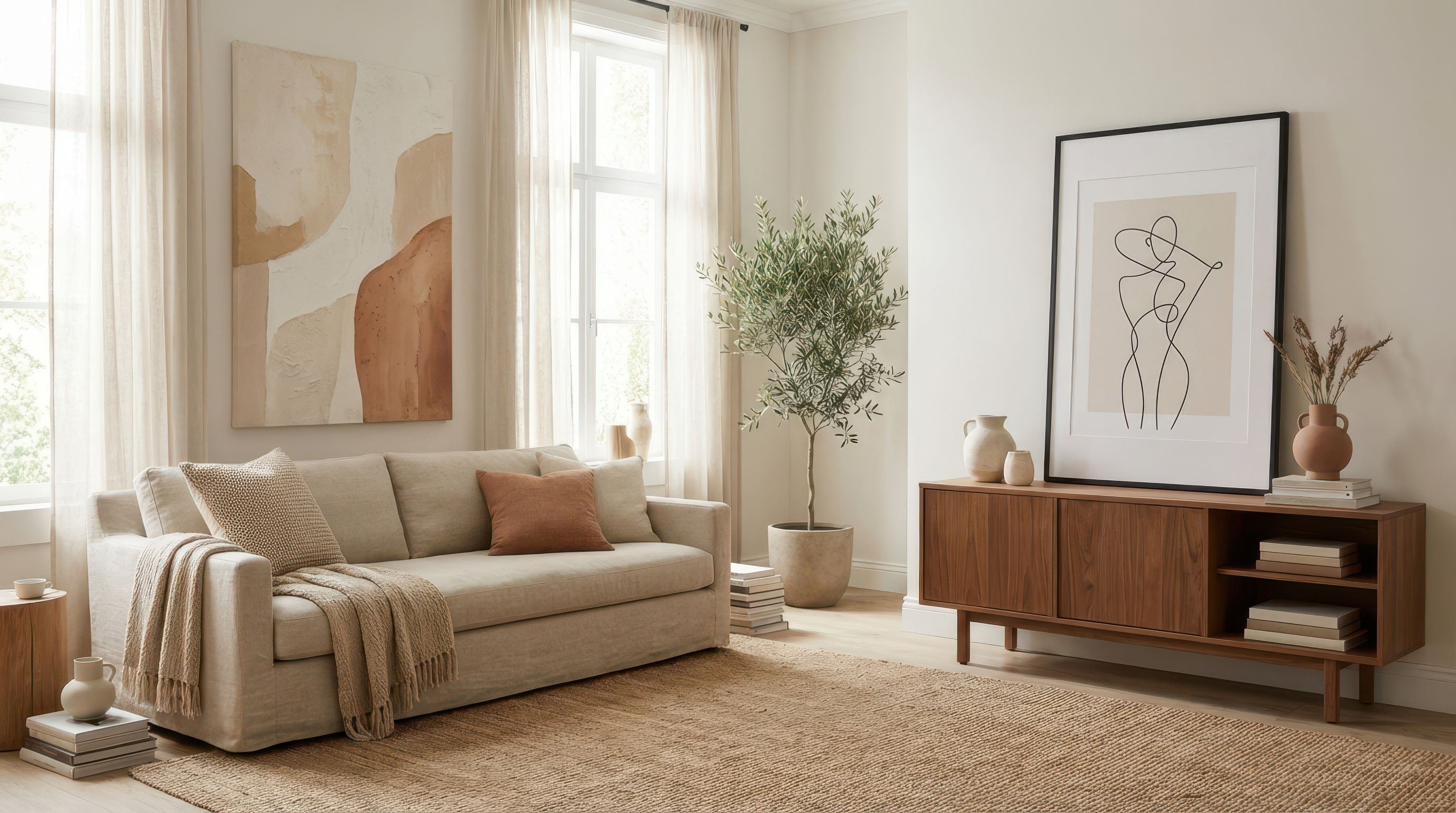

Artículo: How to Choose the Right Wall Art Size for Every Room
How to Choose the Right Wall Art Size for Every Room
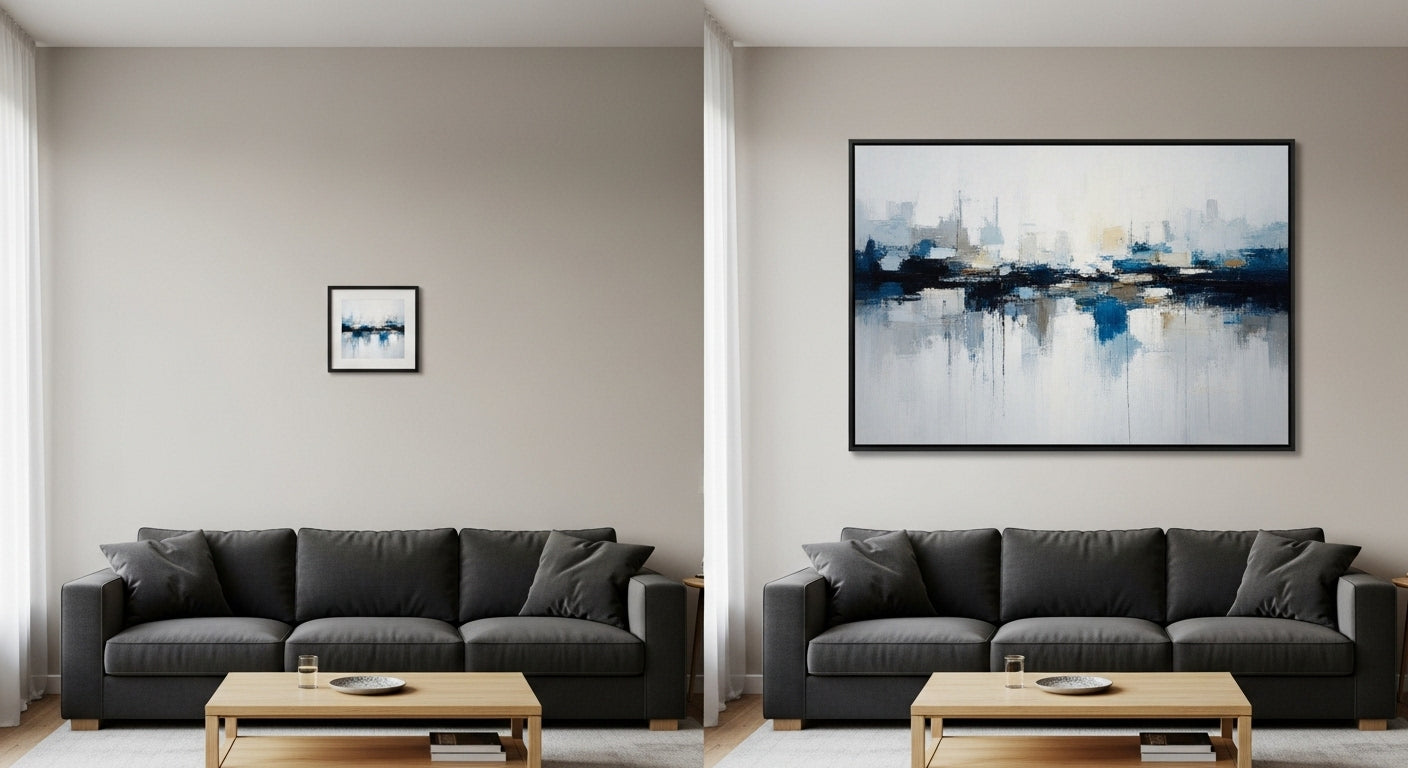
Most wall art is bought a size too small. Not because people choose badly, but because a canvas that looks large on a screen looks modest on a wall, and there is no obvious way to check before it arrives. This guide fixes that with measurements you can take in about two minutes.
Every size named here is one we actually print, so you can follow the advice straight through to a product page.

Three rules that cover most walls
Two-thirds to three-quarters. Art hung above furniture should span about two-thirds to three-quarters of the furniture's width. A 60-inch sideboard wants roughly 40 to 45 inches of art above it. An 84-inch sofa wants roughly 56 to 63 inches. Below two-thirds the piece reads as an afterthought; above three-quarters it crowds the furniture.
The 57-inch line. Hang art so its center sits 57 to 60 inches from the floor. This is the standard galleries use, and it works because it matches average standing eye level.
Six to eight inches. That is the gap between the top of the furniture and the bottom of the frame. Less, and the two objects read as one blocky shape. More than about ten inches, and the art floats away from the furniture it belongs to. When this rule and the 57-inch line disagree, this one wins.

For a bare wall with no furniture beneath it, size to the wall instead: fill about 60 percent of the open space, measured between whatever frames it — a window edge, a corner, the top of a chair rail.
Living room
Above the sofa
Measure the sofa's full width including the arms, then take two-thirds.

| Sofa | Typical width | Art should span | Sizes that fit |
|---|---|---|---|
| Loveseat | 58-64" | 38-48" | 24x36", 30x40", 36x48" horizontal |
| Three-seat sofa | 78-88" | 56-63" | 20x60" or 40x60" horizontal |
| Sectional | 100"+ | 66-75" | 24x72" horizontal, or two 30x40" |
A pair or trio often beats a single canvas over a long sofa. Two 30x40" pieces hung three inches apart span 63 inches together, which suits an 88-inch sofa more comfortably than any single piece in that range.
Feature wall
A wall with nothing under it can take the largest sizes we print: 24x72" or 40x60". For a three-part arrangement, three 16x48" panels hung vertically with three inches between them span 54 inches and suit a tall wall.
Above a console or mantel
Aim for 50 to 75 percent of the console or mantel width. For a standard 54-inch mantel that means 27 to 40 inches: a 24x36", 30x40", or 32x48" hung horizontally. In a room with high ceilings you can layer two pieces vertically instead.
Bedroom
Above the headboard
Beds are measured by mattress width, and the headboard usually extends a few inches past it on each side. Size to the mattress and you will land in the right range.
| Bed | Mattress width | Art should span | Sizes that fit |
|---|---|---|---|
| Twin | 38" | 25-28" | 24x36" vertical, 24x24" |
| Full | 54" | 36-40" | 24x36" or 30x40" horizontal |
| Queen | 60" | 40-45" | 30x40" horizontal, 40x40", or two 18x24" |
| King | 76" | 50-57" | 40x60" horizontal, or two 24x32" |
Bedroom art is looked at in low light, last thing at night and first thing in the morning, so muted low-contrast work wears better here than anything high-contrast. Our bedroom wall art collection is filtered on exactly that.
Opposite the bed and side walls
The wall you face on waking suits a piece with some depth to it — a distant horizon, open sky. On an empty wall, 36x48" or larger holds the space. On a narrow wall, a vertical 24x36" or 12x36" works better than anything square. Beside nightstands, a matched pair of 18x24" pieces creates symmetry without crowding the lamps.
Dining room
Dining rooms are viewed from a chair, which changes both the size and the height. Art width should be 50 to 75 percent of the table length.
| Table | Length | Art should span | Sizes that fit |
|---|---|---|---|
| Six-person | 72" | 36-54" | 24x36" or 32x48" horizontal |
| Eight-person | 96" | 48-72" | 32x48", 40x60", or 24x72" horizontal |
Over a buffet or sideboard, take two-thirds of the furniture width as usual. Because everyone is seated, drop the center of the artwork to about 54 inches rather than 57. Warmer, deeper work holds up better under evening light than pale pieces do — see dining room wall art.
Kitchen
Kitchen walls are usually small, broken up by cabinets and outlets, and rarely lit well. That calls for high-contrast subjects that read at close range, in sizes that fit the gaps.
- Between cabinets: 12x16" or 12x18"
- Above a window or along a narrow run: 12x24" or 16x32" hung horizontally
- Breakfast nook: 24x32" or 30x40", depending on table size
- Above a cart or bench: a single 24x36"
Food and drink subjects sit naturally here — lemons, coffee, wine, herbs, still life — alongside farmhouse scenes. Browse kitchen wall art.
Hallways and stairways
Hallways are viewed from a few feet away and almost never straight on, which makes them the easiest place in a house to hang a series.
- Narrow hallway (under 48"): 12x18" or 16x24" pieces in a row, spaced evenly
- Wide hallway: 24x36" or 30x40", singly or in pairs
- Stairways: follow the angle of the stairs, stepping down in size — 24x36" at the bottom, 18x24" in the middle, 12x18" at the top, keeping three inches between pieces
Keeping one palette across the run holds the sequence together even when the subjects differ. See hallway wall art and entryway wall art.
Home office
Art behind a desk is now art on a video call, and that changes what works. Keep it to one piece or a tight pair — a busy grid reads as clutter on camera. A 24x36", 30x40", or 36x48" centered behind your seated position is the reliable choice.
On the wall you face while working, something with depth gives your eyes somewhere to rest between tasks. Line work, monochrome landscapes, and maps stay legible when a camera compresses them: home office wall art.
Bathroom
Small walls, high humidity, and short viewing distances. Square shapes solve most bathroom walls.
- Above the toilet: 16x24", 18x24", or 20x20"
- Vanity wall: 50 to 60 percent of the vanity width — for a 36-inch vanity, a 20x20"
- Narrow accent wall: 12x16" or 12x18"
Which shape for which wall
Aspect ratio matters as much as size. A tall narrow canvas and a wide horizontal one at the same square footage do completely different things to a room.
| Ratio | Sizes | Best for |
|---|---|---|
| 1:3 — panoramic | 8x24", 12x36", 16x48", 20x60", 24x72" | Vertically: narrow walls, beside doorways, stairwells. Horizontally: above a long sofa or headboard |
| 1:2 | 12x24", 16x32", 24x48", 30x60" | Between windows, above a console, narrow kitchen runs |
| 2:3 — the classic | 12x18", 16x24", 24x36", 32x48", 40x60" | Most walls; the safest choice when unsure |
| 3:4 | 18x24", 24x32", 30x40", 36x48" | Above a bed or dresser; gallery walls |
| 1:1 — square | 20x20", 24x24", 30x30", 36x36", 40x40" | Small awkward walls, bathrooms, alcoves, symmetrical pairs |
A vertical piece draws the eye up and makes a low ceiling feel taller. A horizontal piece widens a room and settles a tall wall down. If a wall feels cramped, try changing the orientation before changing the size.
Gallery walls and multi-piece sets
Treat a group as one shape. Measure the whole arrangement, outer edge to outer edge, and apply the two-thirds rule to that total.
Keep two to three inches between frames. Wider and the group stops reading as a unit; tighter and it looks crowded. Lay the arrangement on the floor first and adjust there — it takes ten minutes and saves a wall full of holes.
For a symmetrical grid, use one size throughout. For a looser arrangement, anchor it with the largest piece slightly off-center and build outward, keeping the gaps consistent even as sizes vary.
Ceiling height and room proportions
- Eight-foot ceilings: standard sizing applies
- Nine to ten feet: go up roughly 10 to 20 percent, or hang two pieces vertically
- Cathedral ceilings: vertical 1:3 panoramics carry the height better than anything wide
- Long narrow rooms: several pieces spaced evenly beat one large one
- Busy patterns already in the room: fewer, larger, simpler pieces
Check the size before you buy
Two ways to be certain, both free.
Use the AR preview. On any product page you can place the artwork on your own wall at true scale through your phone camera, and judge it against your actual furniture before ordering. It answers the size question in about thirty seconds.
Or tape it out. Mark the dimensions on the wall with painter's tape and live with the outline for a day. View it from the doorway and from where you sit. Most people go one size up after seeing the rectangle in place.
Common sizing mistakes
- Going too small. The most common error by a distance. When torn between two sizes, take the larger one.
- Hanging too high. Center at 57 to 60 inches, not the top edge at eye level.
- Measuring the wall instead of the furniture. Above a sofa, the sofa sets the size.
- Matching the furniture width exactly. Two-thirds looks considered; full width looks like a headboard.
- One small piece on a large wall. Either size up or build a group.
When to break the rules
Oversized art in a small room can make it feel larger rather than smaller. A dense grid of many small pieces reads as pattern rather than as individual works. A single floor-to-ceiling vertical in a narrow space is a deliberate choice that no proportion rule would suggest. These work when they are clearly intentional — the failure mode is art that looks accidentally mis-sized, not art that looks boldly sized.
Quick reference
| Situation | Rule | Common sizes |
|---|---|---|
| Above a three-seat sofa | 56-63" span | 20x60", 40x60" |
| Above a queen bed | 40-45" span | 30x40", 40x40" |
| Above a king bed | 50-57" span | 40x60", two 24x32" |
| Dining wall | 50-75% of table length | 32x48", 40x60" |
| Kitchen gaps | Fit the gap | 12x16", 12x24" |
| Hallway series | 3 or 4 in a row | 12x18", 16x24" |
| Behind a desk | One piece or a pair | 24x36", 30x40" |
| Bathroom | 50-60% of vanity | 20x20", 18x24" |
| Hanging height | Center 57-60" from the floor; 54" in a dining room | |
| Gap above furniture | 6-8 inches | |
| Between frames | 2-3 inches | |
| Unsure of shape | Choose 2:3 | |
Every size above is printed to order on gallery-grade canvas, in eight frame finishes or stretched without a frame. Browse by room in living room, bedroom, dining room, kitchen, entryway, and hallway wall art.